
Quick Answer: How Should You Visit Shuanglin Temple?
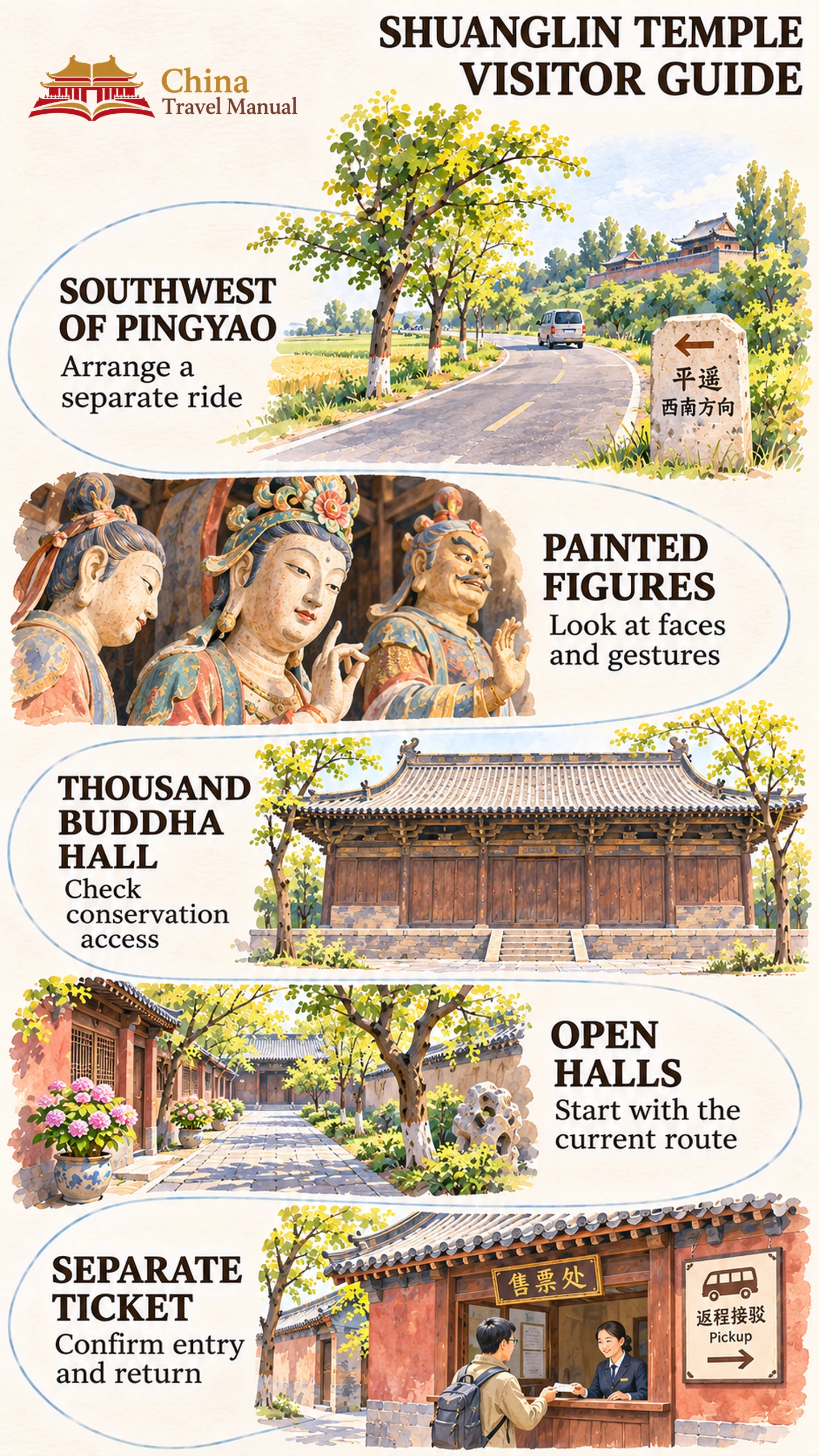
Allow a separate short outing southwest of Pingyao. Check entry to the Thousand Buddha Hall (千佛殿, Qiānfó Diàn) before you go. The temple can be open while parts of that hall are restricted for conservation.[1][2][3]
- Start with the current route: Ask which halls are open, then choose two or three where you can look closely.[2][3]
- Look for painted figures in groups: Compare poses, faces and clothing from the areas where visitors are allowed to stand.[1][2][4]
- Book the road transfer and ticket separately: Admission is separate from Pingyao’s old-town pass.[1][5]
If you came for one particular sculpture, ask about its visibility before committing to the trip.[2][3]
Shuanglin Temple (双林寺, Shuānglín Sì) is a good short outing from Pingyao for painted temple sculpture. Its figures belong to groups inside different halls, where faces, gestures and colors help tell the stories. Check which halls you can see before buying admission. The temple’s conservation program affects access to one of its principal sculpture rooms.[1][2]
Tickets, Location and Current Conservation Work
UNESCO places the temple about six kilometers southwest of the Pingyao county seat. For navigation, use the Chinese temple name or 28 Shuanglin Main Street, the address listed by the attraction guide. Confirm the pickup and return if your lodging is inside the city wall, and leave time to walk from your room to a point vehicles can reach.[1][4]
Conservation work in the Thousand Buddha Hall began in July 2026. It uses staged restrictions to protect the paintings and sculptures. The reported program runs into 2028, with other halls expected to remain open during the work. Check the latest conditions before traveling because partial access can change by stage. The Water-Moon Guanyin (水月观音, Shuǐyuè Guānyīn) and the standing guardian Weituo (韦陀, Wéituó) are associated with the hall, so seeing those particular figures depends on what is accessible.[2][3]
The scenic-area operator listed CNY 35 as the full-price temple ticket in its September 2026 notice. A dated winter timetable introduced in October 2026 listed 08:00–17:30 and last admission 15 minutes before closing. Verify the current price and hours. Bring the travel document required by the booking channel and ask the operator if your passport type is not shown. Use the Pingyao travel budget to count the temple and its ride as separate costs.[5][6]
What to Look for in the Painted Figures
UNESCO highlights more than 2,000 painted sculptures at Shuanglin, with numerous examples from the Ming and Qing periods. What stands out is the variety within groups. Start with the larger figures and let your eye move toward smaller figures or scenes along the sides. View the figures from the allowed public area, since some rooms or sightlines may be restricted.[1][2][4]
| Where to focus | What to look for | What to check |
|---|---|---|
| Heavenly Kings Hall | Large guardian figures and the space they take up near the entrance.[4] | Whether the hall is on the open route. |
| Shakya Hall | A sequence of modeled scenes along the walls.[4] | Which portions you can see from the public side. |
| Thousand Buddha Hall | The group of painted figures around its central subjects and guardians.[2] | Current conservation barriers and access.[2][3] |
Take a moment to compare expressions, the direction a figure is looking and where the folds of the clothing lead your eye. Look for who faces whom and which groups share a scene, even if the current route shows only part of a room. Follow signs and staff instructions on photography, and let your eyes adjust naturally in dim interiors.[1][2][4]
If the two famous figures in the principal hall are visible, compare the relaxed seated pose of Guanyin with the upright stance of the guardian. You can apply the same way of looking elsewhere on the open route. The large guardians make a strong first comparison with the smaller narrative figures in Shakya Hall. The different scales are easier to notice if you spend time at one doorway before moving deeper into the compound.[2][4]
Shuanglin or Zhenguo for a Short Visit
Choose Shuanglin for sculpture and Zhenguo Temple for early timber construction. Both are protected parts of the UNESCO property and have separate admissions. The two temples also have separate routes and different conservation constraints. Compare current hall access and the Pingyao day trips guide before putting both on the same day.[1][2][5]
How to Plan a Shuanglin Temple Visit
- Ask what is open before paying. Check the attraction’s gate operation and access to the specific hall you came to see.[2][3][6]
- Plan a round-trip road transfer. Show the driver the Chinese temple name and agree where to meet after the visit.[1][4]
- Choose the best open sculpture rooms. Give yourself time to see groups as well as individual pieces.[1][4]
- Keep the rest of the day flexible. Use the things to do in Pingyao guide to choose an old-town stop after your return.
FAQs About Shuanglin Temple
Can I see the Thousand Buddha Hall now?
Check on the day. Staged conservation from July 2026 can restrict some parts of the hall or the view of particular works. Other halls can still be open.[2][3]
Is the temple included in the Pingyao pass?
The scenic-area operator lists a separate admission for Shuanglin Temple. Add the road transfer as a further expense.[1][5]
How long should I allow at Shuanglin Temple?
Start with a half-day block from Pingyao including your ride. The time inside depends on how many halls are accessible and how long you want to look at the sculpture.[1][2][3]
Sources
[1] UNESCO World Heritage Centre. Ancient City of Ping Yao, including Shuanglin Temple
[2] China News Service. Staged conservation at Shuanglin and Zhenguo temples
[3] Qunar. Current Shuanglin Temple visitor and conservation notice
[4] Trip.com. Shuanglin Temple address and descriptions of the halls
[5] Pingyao Ancient City Scenic Area operator. September 2026 reference admissions
[6] Pingyao Ancient City Scenic Area operator. October 2026 winter hours notice





