
Quick Answer: Is It Better to Take the Train or Fly in China?
For a first trip to China, choose between a high-speed train and a domestic flight by comparing the full journey from one hotel to the next—not just the time printed on a timetable. A three-hour direct train often beats a short flight once airport transfers and check-in are counted. Longer routes are less predictable, and a nonstop flight may save most of a sightseeing day.
- Short direct routes: Start with trains for Shanghai–Hangzhou and Chengdu–Chongqing.
- Four- to six-hour train routes: Compare both options for Beijing–Shanghai and Beijing–Xi’an, including the exact departure and arrival points.
- Long distances: Look at nonstop flights first for Shanghai–Chengdu or Beijing–Urumqi, especially on a one- or two-week itinerary.
- Luggage and family needs: Compare the effort of carrying bags through stations with airline check-in, baggage claims and any extra fees.
- Before you pay: Check actual availability, your hotel locations and the change or cancellation terms for that specific departure.
The familiar “take the train if it takes under four hours” rule is a useful screening shortcut, not a guarantee.
Traveling between Chinese cities can involve a sleek train, a convenient flight, or a surprisingly long trip to the wrong terminal. The best choice depends on the stations and airports serving your particular itinerary. This guide uses indicative 2026 route times, not live booking quotes; verify schedules, fares and availability before paying.
China Train vs Flight: A Quick Comparison
| Factor | High-speed train | Domestic flight |
|---|---|---|
| Usually best for | Short or medium-length direct corridors | Long journeys, rail detours or missing rail connections |
| Overall time | Competitive when stations are accessible | Competitive when flight is nonstop and airports are convenient |
| Ticket cost | Depends on train, date and class | Depends on airline, date, fare conditions and extras |
| Luggage | You carry and store bags; railway limits apply | Cabin and checked-bag rules vary by airline and fare |
| Departure process | Station entry, security, ID checks and boarding gate | Check-in, possible bag drop, security and boarding |
| During the trip | Space to get up; longer time onboard | Less time in transit on long routes; movement restricted at certain stages |
| Changes or disruptions | Rail rules and operating conditions apply | Airline and fare rules plus flight operations apply |
Neither mode is universally cheaper, faster or more reliable. The route’s exact endpoints, the ticket available on your travel date and any onward commitments matter more than a national average.
Which Is Faster: High-Speed Train or Flight Door to Door?
The Full High-Speed Train Journey
Add five things: travel from your hotel to the correct railway station, time for security and passport checks, time on the train, station exit, and the final transfer to your next hotel. A convenient rail route can avoid baggage check-in and the longer preflight process, but station location changes the result.
Beijing South (Beijingnan) is not Beijing West (Beijingxi). Likewise, Shanghai Hongqiao is not Shanghai Railway Station. These are separate points on a city map; entering only “Beijing” or “Shanghai” in a planning app can conceal an important ground transfer. See the China railway station guide before estimating the first and last legs.
For many travelers, arriving 30–45 minutes before a familiar high-speed departure is a planning estimate, not a guaranteed minimum. Choose a larger buffer at an unfamiliar giant station, with children, with a foreign-passport manual check or during a holiday. The actual boarding cutoff is the station’s rule, not the suggested arrival window.
The Full Domestic Flight Journey
The flight calculation starts at your hotel, then includes the airport transfer, check-in and bag drop if needed, security, boarding, the scheduled flight and ground movement, baggage reclaim if applicable, and the trip from the arrival airport to your hotel.
An airline’s check-in cutoff is not advice on when to reach the airport. For example, China Eastern lists domestic check-in closing 30 minutes before departure at Beijing Capital Terminal 2, 35 minutes at Beijing Daxing, and 40 minutes at Shanghai Pudong Terminal 1. These airline-specific cutoffs can change. For trip planning, arriving approximately two hours before a domestic flight—or allowing more at a large airport or peak season—is a more cautious starting point.<sup>[2]</sup>
Shanghai illustrates the importance of the endpoints. Official city transport guidance describes about an hour by metro from Pudong Airport to People’s Square, while Hongqiao Airport has closer connections to central Shanghai. A flight using Pudong might be less convenient than the same flight operating from Hongqiao; the city’s Airport Link is another option between its two airports.<sup>[3][9]</sup>
Illustrative door-to-door calculation, not a quoted schedule: a 4-hour-40-minute train plus 40 minutes to the station, 40 minutes at the station, 15 minutes to exit and 35 minutes onward totals about 6 hours 50 minutes. A 2-hour-10-minute flight with 65 minutes to the airport, 2 hours of preflight time, 35 minutes for arrival formalities/baggage and 50 minutes onward totals 6 hours 40 minutes. In this hypothetical case the flight barely wins. Change either hotel’s location and the result may reverse.
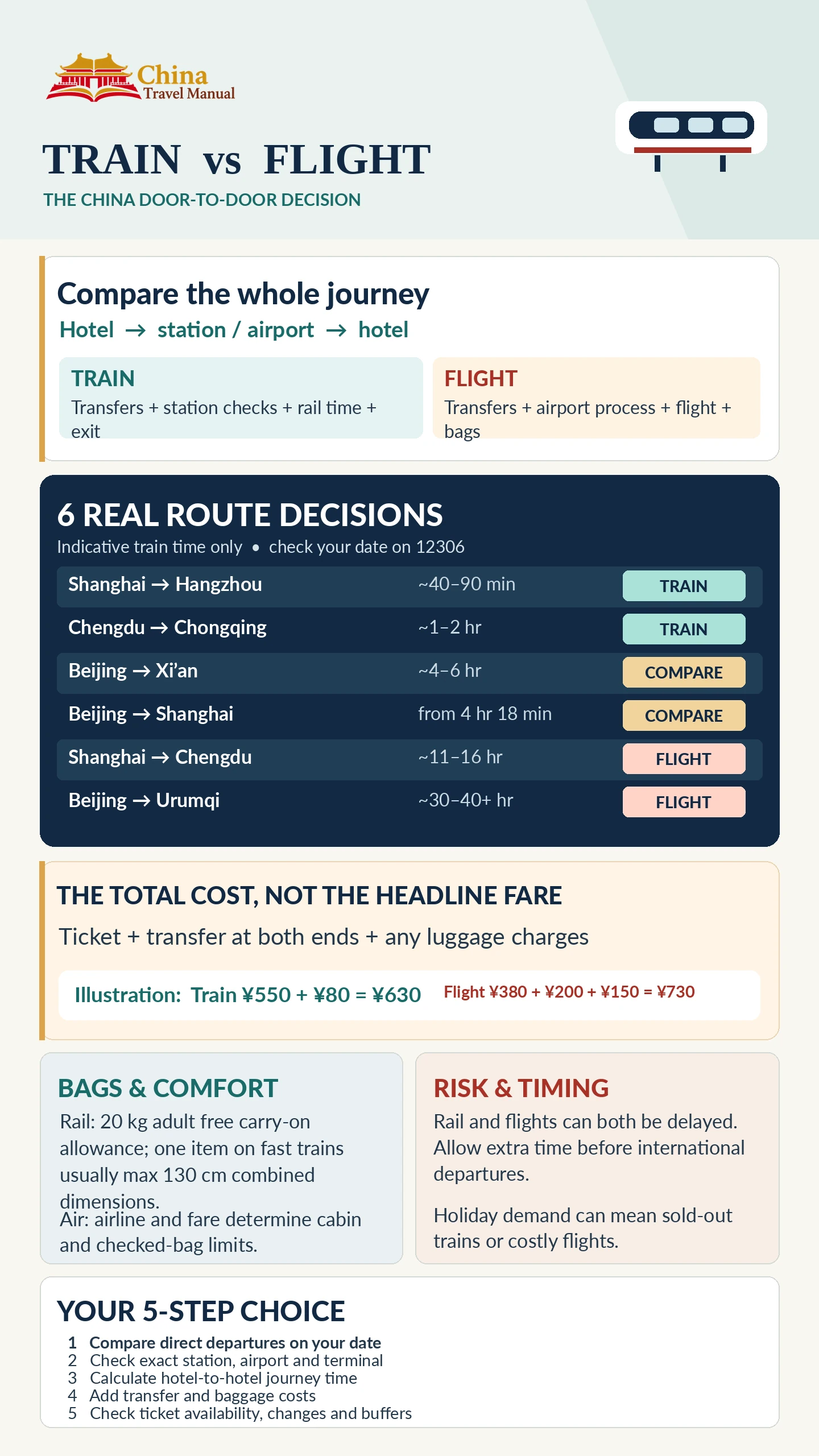
Train or Flight? Real China Routes Compared
The table gives indicative onboard railway times for representative direct services, not door-to-door times and not guaranteed options on a particular date. Actual runs vary by stops, service category and timetable changes; check the official 12306 booking system before making a commitment.<sup>[4][5][6][7]</sup>
| City pair | Indicative direct rail time | Where to start |
|---|---|---|
| Shanghai → Hangzhou | About 40–90 minutes | Train |
| Chengdu → Chongqing | About 1–2 hours | Train |
| Beijing → Xi’an | Roughly 4–6 hours | Compare both; train often attractive |
| Beijing → Shanghai | Fastest services about 4 hr 18 min; many take longer | Compare both |
| Shanghai → Chengdu | Around 11–16 hours on direct fast services | Flight often saves a day |
| Beijing → Urumqi | Around 30–40+ hours on direct rail services, depending on train | Usually flight for a short visit |
Short Routes Where Trains Usually Win
Shanghai–Hangzhou and Chengdu–Chongqing are strong rail candidates. Frequent direct services and relatively short onboard times mean the airport process rarely adds value for an ordinary city-center-to-city-center trip. For Shanghai–Hangzhou, however, book the correct arrival station: Hangzhou East and Hangzhou Railway Station are not interchangeable for your onward transfer.
A flight could still make sense if it is part of a longer connecting airline itinerary. But for two separate hotels, rail should be the first search.
Medium-Distance Routes Where Both Options Compete
Beijing–Shanghai is the classic close call. The fastest high-speed services take about 4 hours 18 minutes; other services take considerably longer. Beijing South and Shanghai Hongqiao may be convenient for one traveler, while a well-timed flight between airports close to another traveler’s hotels could win.<sup>[4]</sup>
Beijing–Xi’an is similarly sensitive to endpoints and departure times. A roughly five-hour direct train may be comfortable and predictable for your personal itinerary; a flight can be better when your hotel is near an airport or you find a suitable nonstop at a competitive total price.
For both routes, check the actual date, station names, departure times and luggage before assuming an answer.
Long-Distance Routes Where Flying Usually Saves Time
Direct fast trains between Shanghai and Chengdu can occupy approximately 11–16 hours; a nonstop flight takes a fraction of that time in the air. For a weeklong holiday, the hours recovered can be worth more than a small fare difference.<sup>[5]</sup>
Beijing–Urumqi is an even clearer example for a traveler with limited vacation time. Published 2026 direct rail schedules include trips around 30 hours and much longer, while direct flying generally occupies only part of a day once airport transfers are included.<sup>[6]</sup>
The exception is intentional slow travel: an overnight sleeper, a planned stop along the route, or a railway journey that is itself part of the experience. Do not confuse these choices with the fastest way to reach the next destination.
Is Taking the Train Cheaper Than Flying in China?
Train fares are not automatically cheaper. Railway prices can differ by service and seating class, while domestic airfare fluctuates with booking dates, discounts and ticket conditions. A deeply discounted flight may undercut second-class rail on a long route, but the final paid cost is what matters.
| Cost item | Train | Flight |
|---|---|---|
| Ticket | Chosen service and seat class | Chosen fare and its conditions |
| Getting there | Hotel to departure station | Hotel to departure airport |
| At departure | Any relevant add-on or baggage handling | Possible checked baggage or other paid extras |
| On arrival | Station to hotel | Airport to hotel, including late-night surcharges if relevant |
| Flexibility | Railway change/refund terms | Specific airline and fare change/refund terms |
Illustration, not current fares: suppose a train ticket costs CNY 550 and local transfers total CNY 80, giving CNY 630. Suppose a flight is advertised for CNY 380, but transfers add CNY 200 and a checked-bag charge adds CNY 150, giving CNY 730. The apparently cheaper airfare costs CNY 100 more. Conversely, an airline fare that includes baggage and lands at a convenient airport could be the less expensive choice.
Check the full checkout amount for the exact booking. Airport railway links may cost far less than a private taxi; Shanghai’s official airport information lists several public transport options, so a flat “airport transfer costs CNY 260” assumption is not defensible.<sup>[3]</sup>
If time is tight, consider what losing six hours of your itinerary would mean, but keep that time value separate from actual cash expenses. For wider budget planning, see how much a China trip costs.
Luggage, Comfort and Traveling with Children
Luggage and Security Rules
China’s railway luggage allowance is not unlimited. China Railway’s published rule gives most adult passengers a free personal-items weight limit of 20 kg; on EMU/high-speed trains, the combined external length, width and height of a single item generally must not exceed 130 cm, and an item may not exceed 20 kg. Foldable strollers accompanying infants and qualifying assistive wheelchairs have stated exceptions. Check the precise rules before carrying an oversized suitcase.<sup>[1]</sup>
You normally move and stow your own train luggage. This avoids baggage reclaim, but lifting a large bag onto racks or into a crowded carriage can be awkward. Keep aisles clear and do not assume an available space near your seat.
Airline cabin and checked-baggage allowances are not identical across carriers or fare products. Compare the actual fare’s included allowance and oversized-bag or stroller handling rules; also review safety restrictions for batteries and liquids. Do not assume that a domestic economy fare always includes one free 20 kg checked bag—or that every flight charges extra.
Seating, Comfort and Family Travel
A second-class high-speed train seat is often a good value for short to medium journeys. Walking to the restroom or stretching during permitted periods can be easier than on an aircraft. Families may appreciate being able to access snacks, books and nearby bags without waiting for checked luggage afterward.
But “more comfortable” depends on how long you will be aboard. A five-hour train may feel easier than a full airport process for one family and exhausting for another. A 12-hour daytime train uses up much more vacation time than a flight, even if the ride is spacious. Older travelers and passengers needing assistance should consider walking distances, station lifts, boarding arrangements and aircraft or rail accessibility services. Specific support must be arranged with the operator rather than assumed.
If you want a fuller breakdown of luggage dimensions and train-specific items, see luggage rules on China trains.
Delays, Peak Holidays and Booking Flexibility
Weather, Delays and Missed Connections
Neither system is immune to disruption. Flights may be delayed or canceled by storms, poor visibility, airport restrictions, air traffic and airline operations. Rail services can be affected by heavy rain, snow, infrastructure issues or temporary restrictions. There is no credible single on-time percentage that predicts your specific train or flight.
The cost of disruption matters most when your next commitment is unforgiving: an international departure, a cruise, a nonrefundable tour or a remote transfer. Avoid scheduling a separate domestic train or flight to arrive shortly before an international flight unless the itinerary and any protected connection rules support it. A previous-night arrival is sometimes the safer choice for a high-stakes departure.
Refund or rebooking rights differ by provider, ticket conditions and cause. A canceled flight does not automatically mean every incidental hotel or transfer expense will be reimbursed. Likewise, do not assume a late train includes a guaranteed onward airline connection. For specific remedies, use the China flight delay guide or train refund and change rules.
Ticket Availability and Holiday Travel
Spring Festival, Labor Day and National Day can alter the comparison. The train that would be ideal on an ordinary Tuesday might have no available second-class seats; a conveniently timed flight might become expensive or sell out. During the July–August school break, family travel demand can also be high on popular routes.
China Railway’s regular advance-sale period is generally 15 days, including the travel date, subject to official adjustments. An early third-party booking request is not the same as an issued railway ticket.<sup>[8]</sup>
For high-demand dates, first look at what is genuinely bookable. If your preferred train is sold out, check the official China train waitlist, different departures, a nearby station or a flight. If both options are poor, adjusting the intercity travel date may be better than accepting a very late arrival. The public holidays guide explains the calendar-level crowd risks.
How to Choose Between a Train and a Flight for Your China Itinerary
Use these five steps when you are ready to book; they should take you from an attractive headline price to a workable itinerary.
- Search direct trains on 12306 and nonstop flights through the airline or a reliable booking channel for the same travel day. If neither exists, compare the actual connections instead of hypothetical direct times.
- Record the full station names and airport terminals. Beijing South, Beijing West, Beijing Capital and Beijing Daxing are different places; so are Shanghai Hongqiao and Shanghai Pudong.
- Calculate hotel-to-hotel time with security or check-in allowance, exit time, luggage reclaim where needed, and realistic transfers at both ends.
- Add the ticket fare, both ground transfers and any baggage charges; compare total out-of-pocket expense on the same assumptions.
- Confirm seats or flight inventory, departure and arrival times, change/cancellation terms and a reasonable buffer before the next reservation.
If the train wins, see how to book China train tickets. If the flight wins, check the China domestic flights guide for airline booking and airport procedures.
FAQs About Trains vs Flights in China
Is It Better to Take the Train or Fly from Beijing to Shanghai?
There is no universal winner. Fast trains can take about four and a half hours between stations, but a nonstop flight can compete when airports, ticket times and hotels line up. Compare the full door-to-door trip and total paid price for your exact date.<sup>[4]</sup>
Are High-Speed Trains Cheaper Than Domestic Flights in China?
Not always. Airline promotions sometimes beat a train’s second-class fare. Conversely, a flight can cost more after adding airport transfers and bags. Compare the final checkout amount, not the fare shown in the first search result.
Is a Four-Hour Train Journey Better Than Flying?
Often, if both railway stations are convenient. A four-hour train usually avoids a longer airport process, but a nearby airport, inconvenient station or well-timed flight can reverse the advantage. Four hours is a rule of thumb, not a booking rule.
How Early Should I Arrive for a Train Compared with a Flight?
A planning buffer of roughly 30–45 minutes for a high-speed station and around two hours for a domestic flight is a useful starting point; increase it for unfamiliar terminals or peak travel. Official boarding and airline check-in cutoffs vary and can be earlier than you expect.<sup>[2]</sup>
Should I Fly Between Distant Chinese Cities?
Usually consider a nonstop flight first when rail requires most of a day or more. Shanghai–Chengdu and Beijing–Urumqi are clear examples for shorter vacations. Choose rail deliberately if the scenery, sleeper experience or intermediate stops are part of the trip.<sup>[5][6]</sup>
Sources
[1] China Railway 12306. Railway baggage weight and size rules.
[2] China Eastern Airlines. Check-in counters and boarding gate closing times.
[3] Shanghai Municipal Government. Transportation at Shanghai airports.
[4] TravelChinaGuide. Beijing–Shanghai high-speed railway timetables, updated July 2026.
[5] TravelChinaGuide. Shanghai–Chengdu train schedules, updated July 2026.
[6] TravelChinaGuide. Beijing–Urumqi train schedules, updated July 2026.
[7] Shanghai Travel. Indicative high-speed rail journey times.
[8] China Railway 12306. Ticket sales and advance-booking rules.
[9] Shanghai Municipal Government. How to take the Airport Link Line.





