

Quick Answer: Can You Travel in China During Typhoon Season?
Yes, many trips can go ahead during China’s typhoon season. July through September is the main landfall period in historical records, and storms can affect the southern and eastern coast outside those months.[1][2]
- Build in time: Leave a spare night on the mainland before a fixed international flight if your route starts on an island or depends on a coastal connection.
- Check your whole route: Read the warnings for your departure point, destination and transfer stops. Confirm the status of each flight, train or ferry separately.
- Act on local instructions: If authorities tell you to evacuate or shelter, follow that instruction before making new travel plans.[3]
Decide whether to travel using the forecast and operating notices for your exact dates.
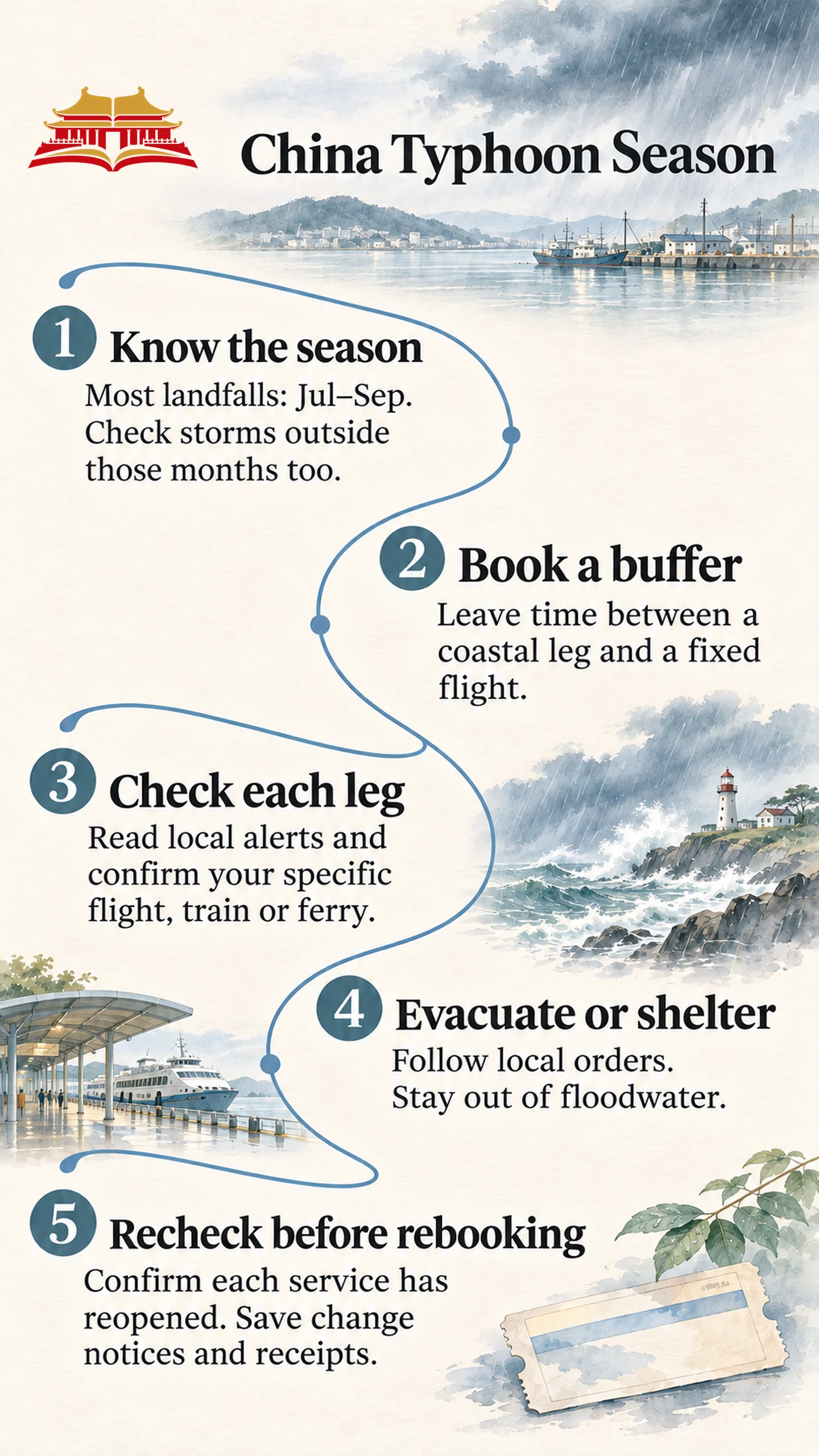
A typhoon can interrupt a trip before the storm reaches land. A ferry may stop taking passengers, a coastal train may be canceled, and a clear forecast at your hotel may say little about the station you need to reach. Start by identifying the connections your itinerary depends on. Then use local alerts and operator notices to decide whether to keep, move or postpone those legs.
When and Where Typhoons Affect China Travel
About three quarters of the tropical cyclones that made landfall in China in a 1949–2022 study arrived from July through September. August had the most landfalls. For coastal planning, treat May through November as a wider watch period. There is no fixed start or end date for storms.[1][2] For ordinary rain patterns by region, see traveling in China during the rainy season.
| Trip area | What a storm can change | What to check |
|---|---|---|
| Hainan and the Guangdong coast | Island flights and ferry crossings can be suspended.[2][4] | Check your specific airport and any Qiongzhou Strait crossing. Do the same for rail service into or out of the island. |
| Fujian and Zhejiang | Coastal rail, ferries and exposed attractions can be affected.[1][2] | Check port and railway notices. If your Xiamen stay includes Gulangyu, check the ferry and return schedule independently. |
| Shanghai and the lower Yangtze coast | Wind and rain can affect an airport or onward connection, even during a city-based stay. Shanghai experienced a direct landfall during Typhoon Bebinca in September 2024.[2][5] | Check the flight and the city transfer you need to reach it. |
| Inland destinations and transfers | Rain can reach inland, and a flight into an inland city can still be affected by conditions at its origin or connection.[2][3] | Check rain and flood warnings along the transfer as well as at the destination. |
How to Book a Trip With Room for Disruption
- Put the buffer where it matters: If you are combining Hainan with mainland China, schedule a mainland overnight before a firm long-haul departure. Put the buffer after the island leg so it can absorb a delay. Allow more time if the alternative route is limited or missing the flight would be costly.
- Know what can move: Before paying, read the change and refund terms for each coastal leg and hotel. On separate-ticket connections, check what each booking covers if the other is disrupted. Read the weather and interruption terms of your China travel insurance, including any exclusions tied to when you bought it.[3]
- Build an alternative you would enjoy: If your dates are fixed and spending time on open water is optional, consider a mainland city itinerary such as Beijing and Xi’an. Use local forecasts there too. If your dates are flexible and the beach is the reason for the trip, compare a different time of year before you book.
What to Do When a Typhoon Approaches
- Read the latest track and local warnings. Look up the dates and districts you will pass through. The official storm tracker shows forecast tracks, and the warning dashboard lists local signals.[6][7] Use both when checking weather alerts. Pay attention to heavy rain, wind and coastal flooding even outside the center line.
- Confirm every essential leg. Check the operator’s notice for your exact departure and the land route to the terminal. Before Super Typhoon Ragasa in 2025, authorities announced both Qiongzhou Strait ferry suspensions and restrictions on rail services in Guangdong.[4] Verify a replacement with its own operator before relying on it.
- Follow evacuation or shelter instructions. If local authorities order evacuation, leave promptly as directed and take essential medication and documents. If local authorities advise people to stay put, shelter inside a safe building. Keep away from windows during strong winds. Stay off beaches and waterfronts affected by the storm, and never walk or drive through floodwater.[3][8]
Ask your accommodation how it sends local updates. Keep your phone charged, your hotel address and bookings available offline, and the details for getting emergency help in China within reach.
How to Rebook After a Suspension
Wait for a service-specific reopening notice. When Hainan began restoring transport after Super Typhoon Yagi in 2024, certain airports and the eastern rail loop resumed before some other rail services.[9] One reopening tells you about one segment, so verify the rest of your route before you leave your accommodation.
Start with the booking that would be hardest to replace, such as an international departure. Then recheck the rest of the route and your accommodation. If you face flight delays or cancellations or a canceled train, save the operator’s notice, your original and revised booking details and any receipts. Those records can support a travel insurance claim, subject to your policy terms.
FAQs About China Typhoon Season
Should I cancel a coastal trip booked for August?
August falls in the historical peak. Use the trip’s change deadlines, the local forecast and the options for replacing any suspended leg to decide. If the exact dates are still far off, check the change terms now and watch local alerts as departure approaches.[1][2]
Can a typhoon affect my trip if it stays offshore?
Yes. Wind, heavy rain and unusually high coastal water levels can reach land even when the storm center stays out to sea. Local warnings and service notices are the best guides for your actual route.[3]
Will high-speed trains run if my flight is canceled?
Some trains may run while others are suspended. Confirm your exact train and departure station before buying a replacement ticket. Storms can disrupt rail and air services on the same itinerary.[2][4][9]
When can I go back to the coast after a typhoon?
Wait until local authorities lift restrictions and your intended route or venue reopens. Flooding, damaged roads and disrupted transport can persist after the storm moves away.[3][9]
Sources
[1] He Shanfeng, Li Zheng, Feng Aiqing, Wang Wei, Ma Yunjia, and Wu Shaohong. Variation Characteristics of Landing Tropical Cyclones over China from 1949 to 2022 and Their Influencing Factors
[2] UK Foreign, Commonwealth & Development Office. China Travel Advice
[3] UK Foreign, Commonwealth & Development Office. Extreme Weather and Natural Hazards
[4] State Council of China. South China Goes All Out, Bracing for Super Typhoon Ragasa
[5] China Meteorological Administration. China Climate Bulletin 2024
[6] National Meteorological Center of China. Typhoon Tracker
[7] National Meteorological Center of China. Weather Warning Signals
[8] China Meteorological Administration. Public Meteorological Hazard Prevention Guidelines for Typhoons
[9] State Council of China. China’s Hainan Gradually Resumes Air, Maritime Traffic Following Super Typhoon Yagi





