

Quick Answer: Take a riverside village walk
Allow one to two hours for the river, public lanes and a break. Add time if a heritage room is open or you have booked lunch. Pin the exact village within Zhouhe before arranging a car from Xin County town. [1][4]
- Map search: Use 新县周河乡西河湾古村落.
- Best first walk: Start beside the river and look across at the roofline before entering the lanes.
- Indoors: Ask about the old granary and oil heritage exhibit. Check any demonstration separately. [4][5]
Xihe is a working village with lived-in courtyards. Use public routes and enter buildings only when they are clearly open to visitors.
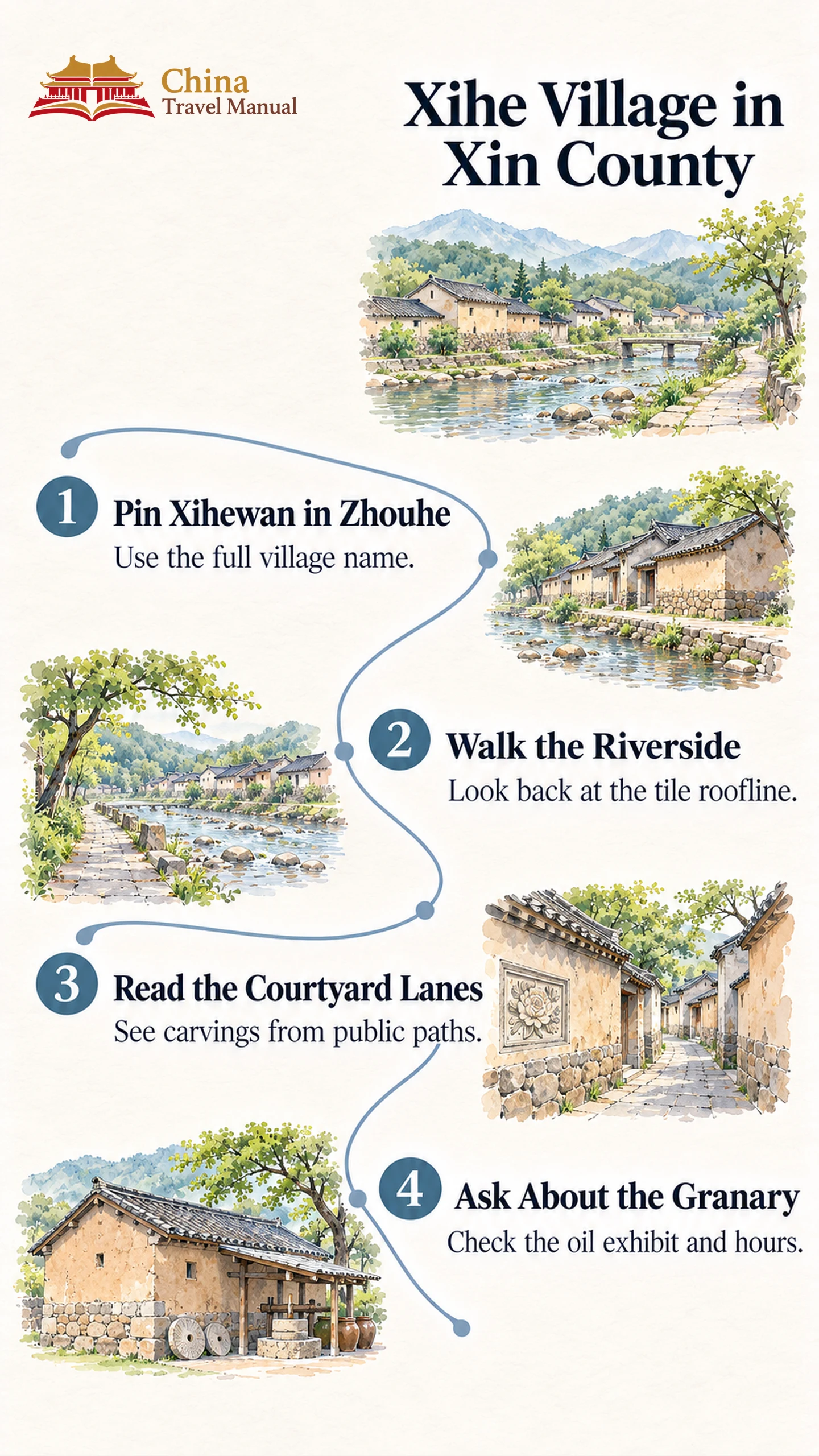
Xihe Village (西河村, Xīhé Cūn) lies in Zhouhe Township, Xin County, in the Dabie Mountains of southern Henan. The historic settlement is commonly listed as Xihewan Ancient Village (西河湾古村落, Xīhéwān Gǔcūnluò). Old courtyard homes stand beside the river below Shizi Mountain. A short walk along the water and through the adjoining lanes lets you see how those two settings shape the village. [1][2][3]
Walk the River and Look at the Courtyard Houses
Begin with the water and look back toward Shizi Mountain (狮子山, Shīzi Shān). From the public lane you can see how tile roofs and enclosed courtyards sit below the slope. Continue along the stone-paved village lanes. The county inventory describes two- and three-courtyard layouts and surviving stone, brick and wood carving. Look for visible stonework and carvings around gateways without stepping into private homes. [1][2][3]
| If you have | Focus on |
|---|---|
| An hour | Riverside view, public lanes and the courtyard façades. |
| Two hours | Add an open heritage room or a village café. |
| Half a day | Stay for a local lunch and leave time for an arranged ride back. |
Add the Granary Exhibit or a Village Break
Ask whether the Xihe grain and oil museum is open. A record of the village project describes how former granaries were reused for a museum and a community activity center. Earlier reports document traditional oil pressing demonstrations. Confirm the current program before making a special trip for a performance. [4][5]
If you prefer a simple stop, Xinhua’s recent village report describes the café 西河村咖 and a drink made with local Xinyang Maojian tea. Treat the café as an optional break and check the day’s hours. Sitting outdoors when the weather suits gives you another look at the linear settlement along the water. [3]
Reach Xihe from Xin County
The village project account places Xihe around 16 km from the county town. Use the full Zhouhe Township pin because Xihe is a common place name. If coming by rail to Xin County, confirm the last leg by car and choose an agreed return pickup point before leaving town. [1][4]
If making a longer trip, Tianpu Dawan and Maopu Dawan are other villages in the ministry’s route. Pin them independently, since their heritage areas involve more road travel. For the wider province, see the Henan travel guide. [2]
FAQs About Xihe Village in Xin County
Are Xihe Village and Xihewan Ancient Village the same visitor stop?
For this trip, use Xihewan Ancient Village in Xihe Village, Zhouhe Township, Xin County. The longer pin identifies the historic cluster. [1][2]
Is the oil-pressing demonstration available every day?
Check in advance. The granary reuse and historical demonstration are documented, but an activity depends on the day’s program. [4][5]
Can I visit without an overnight stay?
Yes. Arrange the round trip from Xin County town and allow one to two hours for the main village walk and a short break. [4]
Sources
[1] Xin County Government | Xihewan and Xin County Villages. Official village location, architecture and terrain.
[2] Ministry of Culture and Tourism | Xin County Village Route. Traditional village designation, houses and neighboring village attractions.
[3] Xinhua | New Uses in Xihe Village. Current village setting and local café examples.
[4] National Practice Education Platform | Xihe Village Reuse. Distance to the county town, village paths and former granary interpretation.
[5] 12371 | Traditional Oil Pressing in Xihe. Documented public visits and oil pressing activity.




